

By John Cavanagh, CIO, Bridge Multimedia
Each May, Global Accessibility Awareness Day invites the technology community to think about digital access: websites, apps, documents, platforms, and the many ways people receive and use information. That conversation should also include free over-the-air (OTA) NextGen TV.
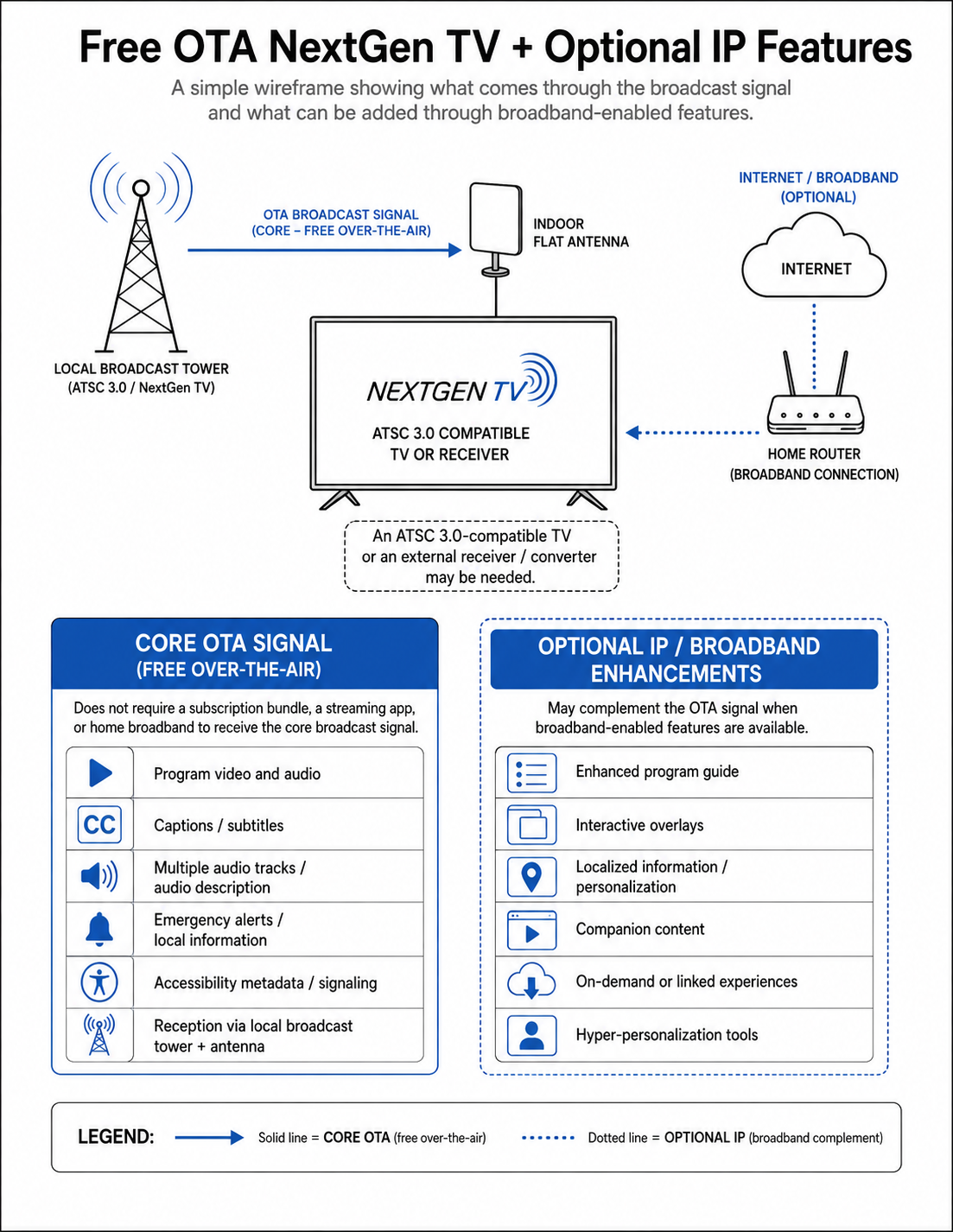
Figure 1. Free OTA NextGen TV and optional IP/broadband complements.
The wireframe below illustrates the core broadcast path and the optional broadband path. A full text alternative for Figure 1 appears after the article.
Read the long description of Figure 1
That free OTA foundation matters. The accessibility significance of NextGen TV begins with what the core broadcast signal does not require: a subscription bundle, a streaming app, or home broadband. At the same time, ATSC 3.0 can support a richer accessibility environment than ATSC 1.0 could practically provide: clearer audio, more flexible captioning, multiple audio-description and language tracks, improved indoor and mobile reception, richer accessibility metadata, signing pathways where provided, and more advanced emergency-alert features.
Personalization is where this accessibility leap becomes most visible. NextGen TV metadata can identify languages, audio-description availability, caption tracks, signing resources, emergency categories, wake-up triggers, dialogue-enhancement options, and simplified-mode indicators. In plain terms, metadata helps a device know what accessibility options are present and how they should be labeled, surfaced, and maintained. Optional IP and hybrid features can add overlays, enhanced guides, localized information, companion content, or other interactive elements. Those tools can support more personalized experiences, but they should be understood as complements to the OTA core, not replacements for it.
Emergency communication is the high-stakes version of the same GAAD question:
Can people receive, understand, and act on critical information when they need it? ATSC 3.0 supports richer emergency messaging, including geotargeting, wake-up signaling where supported, maps, graphics, multilingual information, text, audio, and video. For viewers who rely on captions, audio description, signing, plain language, or multilingual communication, this is where accessibility becomes part of public-service media.
GAAD is a reminder to look across the technology spectrum and ask where access can be made stronger, clearer, and more dependable. That includes the web, apps, documents, devices, and broadcast television. Free OTA NextGen TV gives that mission a concrete broadcast context: everyday access, personalized viewing, and emergency communication delivered through a system designed to reach viewers where they are.
John Cavanagh is Chief Innovation Officer and Director of Corporate Accessibility at Bridge Multimedia, a New York City-based social enterprise dedicated to advancing universal access across educational, entertainment, corporate, and governmental media.
Bridge Multimedia’s work as a NextGen TV content and accessibility developer reflects its broader mission to make 21st-century media more accessible, usable, and inclusive for people with disabilities and cognitive differences.
Description of Figure 1
Figure 1 explains the difference between the core free over-the-air NextGen TV signal and optional IP or broadband-enabled enhancements. On the left, a local broadcast tower sends a solid-arrow over-the-air signal to an indoor flat antenna, which connects to an ATSC 3.0-compatible television or receiver. A note explains that an ATSC 3.0-compatible TV or an external receiver/converter may be needed. On the right, a separate internet cloud and home router connect to the TV by a dotted line, showing that broadband is optional and complementary.
Core OTA Signal (Free Over-the-Air)
The core broadcast signal does not require a subscription bundle, streaming app, or home broadband. It includes:
- Program video and audio
- Captions and subtitles
- Multiple audio tracks and audio description
- Emergency alerts and local information
- Accessibility metadata and signaling
- Reception through a local broadcast tower and antenna
Optional IP / Broadband Enhancements
Broadband features may complement the OTA signal when available:
- Enhanced program guides
- Interactive overlays
- Localized information and personalization
- Companion content
- On-demand or linked experiences
- Hyper-personalization tools
Legend: a solid line represents the core free OTA signal; a dotted line represents optional IP or broadband complements.
Latest Bridge News
Bridge Multimedia Technologies Reimagines Audio Description for 100-Year-Old Silent Film “The Flying Ace”
Bridge Multimedia Technologies produced the audio description for a special centennial presentation of The Flying Ace, the landmark 1926 silent feature with an all-Black cast.
Continue ReadingSep
Bridge Multimedia Technologies Showcases 3 Accessibility Projects at the 2026 AER Conference
Bridge Multimedia Brings Accessible Gaming, Weather Brain, and WISER to the Association for Education and Rehabilitation of the Blind and Visually Impaired 2026 International Conference.
Continue ReadingAug
Bridge Produces Audio Description for VISIONS’ Spotlight on Older Adults Video
Bridge was proud to provide accessibility for VISIONS’ Spotlight on Older Adults video, screened at a NYC Department for the Aging Disability Pride Month event.
Continue ReadingJul
Bridge CEO Delivers Keynote: Welcoming the Future: AI as a Partner in Family-Centered Early Intervention
Bridge Multimedia’s President and CEO, Matt Kaplowitz, delivered the plenary keynote address for the Family-Centered Early Intervention International’s 2026 conference in Austria.
Continue ReadingJun
NextGen Television Belongs in the GAAD Conversation
Global Accessibility Awareness Day offers a timely moment to recognize how free OTA NextGen TV can advance accessible viewing and emergency communication.
Continue ReadingMay
Bridge Multimedia Technologies Partners with The American Printing House for the Blind, PBS KIDS, and The WNET Group, to Expand Audiences for Educational Gaming
Bridge, APH, PBS KIDS, and the WNET Group recently partnered to bring an accessible STEM-based educational video game to children who are deafblind, via the innovative Monarch device.
Continue ReadingApr